Showing posts with label film. Show all posts

Sunday, August 30, 2009

Morris: A Life With Bells On


Finally! Morris Dancing, the movie.

Watch the trailer at the link above and you'll see why I won't miss this.

The Times Online says this about the film, which premiers which opens in Seattle and premiers in selected movie theaters around the U.S. at the end of September.

Sir Terry Pratchett, the bestselling novelist, said in one of his Discworld fantasy novels, The Reaper Man: “The morris dance is common to all inhabited worlds in the multiverse. It is danced under blue skies to celebrate the quickening of the soil and under bare stars because it’s springtime . . .”

Morris dancing is that quintessentially English folk dance trotted out at village fairs and is apparently an underground urban sensation among young ladies who like bouncing about in corsets, bloomers and full skirts. (And who doesn’t?) The lucky men who learn the hanky waves and wear bells on their shins (similar to Jennifer Beals’s legwarmers in Flashdance) to partner them are very confident in their masculinity, and the women know it.

...So how to make morris dancing sexy to Englishmen? Charles Thomas Oldham is doing it in his new film, Morris: A Life with Bells On. Instead of ignoring the obligatory sneering of an English perspective, he has turned it on its ear and made a near-flawless first film that takes the mock out of mockumentary. Morris: A Life with Bells On explores the earnest peccadillos of quirky obsession, without losing the sincerity at the core of a morris dancer’s enthusiasm. The movie is a scripted documentary, created by a company of subtly comic actors who clearly grasp how ridiculous morris dancing may appear, yet perform with enough naive bluster to seduce us into the morris way of life.

By the end of the film you’ll be getting your hankies out and waving, not least because the excellent music score provokes a good jig — including the morris gangsta-rap song by Mr McTwist at the end.

All will be well, as long as they don't do the Dark Morris....

Sia

Related Articles:

Beltane At The Baylands

Thursday, August 06, 2009

Acropolis Movie Won't Be Censored After All

Good news,


Never underestimate the power of YouTube to leapfrog over a censor's red tape.

The latest example involves a battle between Oscar-winning filmmaker Costa-Gavras and the newly opened Acropolis Museum in Greece.

Last week, the director asked to withdraw his credit from an animated short that the museum was showing as part of a larger film about the history of the Parthenon. Officials at the museum had reportedly removed a scene from Costa-Gavras' movie after the Greek Orthodox Church objected to what it saw as a depiction of Christian priests destroying parts of the ancient temple.

But on Tuesday, the Acropolis Museum said it had reversed its decision to cut the film after days of picketing and the threat of a lawsuit.


Sia

Youtube video short found here

My thanks to the wonderful Wren's Nest News site for the link to this story.

Related Articles:

Destroy the Temple, Make a Museum

An Ancient Egyptian Temple Now In New York

Returning: Looking for the Goddess in Malta and in the new films "Agora".

Tuesday, February 24, 2009

To all the gay and lesbian kids out there....


...to all of the gay and lesbian kids out there tonight who have been told that they are less than by their churches, by the government, or by their families, that you are beautiful, wonderful creatures of value and that, no matter what anyone tells you, God does love you, and that very soon, I promise you, you will have equal rights federally, across this great nation of ours.

- Dustin Lance Black, accepting the Oscar for Best Screenplay for "Milk"

Care2 website writes:

The Oscars took place this weekend, and, amongst a year of incredibly strong films, Milk, a film biopic on Harvey Milk, the first openly gay man to be elected into office as a member of the San Francisco Board of Supervisors, won Best Actor for Sean Penn in the role of Harvey Milk, and Best Screenplay for young writer Dustin Lance Black.

You can read his whole acceptance speech and see the video here.

Check out the Care2 website. It's worth your time.


Sia

Videos at blog:

Dustin Black's press conference backstage at the Oscars.

Movie Trailor for Milk

Related Articles:

Joy in the Castro

It's OK To Think Dr. Who is Gay

Monday, August 04, 2008

The Bechdel Test: Women, Movies & Art


Why Women Don't Get The Films We Want To See

Hathor writes:

While writing Female characters exist to promote male leads for network profits, I realized something I had never quite put together in so many words. It’s important enough to deserve its own article (thanks, Bellatrys!), so here it is: my screenwriting professors taught me not to write scripts that passed the Bechdel/Mo Movie Measure/”Dykes To Watch Out For” test, and I can tell you why, and this needs to be known.

Read her post Why film schools teach screenwriters not to pass the Bechdel test, it's worth your time.

Women Impressionists:

I caught the Women Impressionists exhibit at the Legion of Honor during my recent trip to San Francisco. The exhibit is breathtaking and features many well loved works and others that are not often seen or reproduced. The good news: It's amazing and continues on through September 21st; don't miss it, if you have a chance to see it. The Bad News: It's only appearing in one American city. How's that for valuing women's creativity? Given the interest in these works, I'm surprised that other cities did not grab the chance to display such a wonderful and unique grouping of pictures from all over the world. Thank you, San Francisco.

Steven Winn, writing for SF Gate, has interesting things to say about this exhibit

Beyond merely pleasing a crowd, which it certainly will do, "Women Impressionists" invites a certain kind of inquiry in the viewer. Gender is the inevitable open-ended question. Did these female artists paint in a certain way because they were women? Were there things they did - or did not do - because they were women? Is there such a thing as a female Impressionist aesthetic? Or, for that matter, is there any discernible female style?

Choice of subject is one clearly unifying factor. To an overwhelming degree, the pictures on display depict women, mostly at home or in garden settings. Men crop up here and there. Now and then a painter ventures out to the theater, with Gonzalès' velvety "A Loge in the Theâtre des Italiens" a notable example. There are a few landscapes and still lifes, most of them small and self-effacing.

Social constraints surely had much to do with what these artists painted. As Ingrid Pfeiffer writes in her catalog essay, even educated and privileged 19th century women contended with significant "prejudices, prescriptions, and restricted scope for action." Female artists painted what conventions, both external and internally imposed, allowed.

But it's also true that all artists have limitations - of circumstance, inspiration, technique, training and influence. What counts is what they make of the material their lives produce. Rather than presenting a case for the connections and affinities in their work, this show reaffirms the singularity of these four women. Each, in her own distinctive way, found a uniquely expressive language. While these Impressionists may have shared certain social conditions and a visual grammar, the sentences and stories they wrote speak clearly on their own terms.


What wonderful stories they tell. If you desire inspiration and biography to spur your own creativity, you might wish to read more about Berthe Morisot, Mary Cassatt, Eva Gonzalès and Marie Bracquemond. You can also search the web for images of their work. These are women you will want to know.

Sia

Monday, April 14, 2008

Now Touring the U.S - The Singing Revolution

I finally caught a showing of The Singing Revolution. It's a wonderful film, and the story of these courageous people will stay with me for a very long time.

I went with friends of mine, and we saw it last Saturday in Portland. It was a deeply moving experience for all four of us. We went out to dinner together afterwards, and we just couldn't stop talking about it. One friend, a gal who had been very active in the Civil Rights Movement, said that the scenes at the Song Festival grounds brought to mind the powerful, peaceful marches she attended at the National Mall in the 1960's. As a young woman she heard Dr. Martin Luther King gave his famous speech during the Great March. She told us that this film reminded her of those gatherings; times when hope and optimism for the future were something thousands of people shared.

As for me, I walked out of the movie theatre feeling inspired and humble at everything these people had endured and especially at what they had accomplished by peaceful means. I even felt a little hopeful - I haven't felt that way in a very long time. What a wonderful film.

Go see it. Go see it. Go see it.

My original post about the film and the movie trailer can be found in the article linked to below.

Visit their website for a list of screenings to find a showing in your city or sign up to request a screening of the film in your town.

Sia

Related Articles:

The Singing Revolution

Thursday, March 27, 2008

It's Good To Be The King: Lust & Politics in Merry Old England

...and they say history is dull. (1)

Meanwhile, Tudor's star Jonathan Rhys Meyers attended the protest against the planned motorway on the Hill of Tara. The plan will destroy Lismullen Woods and Irish archaeological sites.

Sia

(For those using a reader, here is a video I've put up on my blog, made from the first season of this series).

Endnotes: Added on 3/29

(1) History buffs all over the net are noting where the The Tudors gets it wrong. The creators of this series (like the creators of some recent British films on Elizabeth I) won't let a little thing like historical fact get in the way of their drama. Some scholars are tolerantly amused by this and are pleased to see people taking an interest in our collective history. Others are not so amused.

Professor Robert Bucholz, professor of history at Loyola University of Chicago, gives his opinion on the series in an article titled Corsets and Codpieces:

“I think the Tudors are always in fashion because it is easy – if wrong – to boil down this story into one of raw sex and power,” he wrote via e-mail. “And who doesn’t find that interesting? In fact, the real Tudor story is far more complex AND interesting – involving the haunting memory of the Wars of the Roses, Reformation Era theology, foreign policy, even the price of bread – in ways that actually affected real people’s lives.

....Bucholz suggests the real problem with paying so much attention to the Tudors is that we ignore their royal successors, the Stuarts, who tried to rule England absolutely. That family’s political and cultural battles – the right of habeas corpus, the right against unreasonable search and seizure, parliamentary power of the purse, the religion of the ruler and, above all, whether said ruler is above the law – mirror struggles in U.S. history. In fact, he says, “I would argue that presidential signing statements are merely the Stuart claim to be able to dispense with the law in individual cases.”

“These are all debates that Englishmen and women argued, fought and settled under the Stuarts, culminating in the Glorious Revolution of 1688-89 and the English Bill of Rights, the foundation of our Bill of Rights,” Bucholz says. “But nobody seems to want to make a movie about that.”

Off The Shelf:
Need a good beach read or something for your next vacation? Try The Other Boleyn Girl

Links: (Additional links added on 3/29)

The Tudors mini-series website

The Tudors: Season Two (free Youtube viewing of 2nd season premier)

Nine Things To Know About the Tudors

Tudor History

Animated video with some gross & grisly Tudor facts (the kids will love it).

Tudors Making some unkind cuts


Wednesday, March 26, 2008

4.5 Million People Watch "Bush's War"

4.5 million people watched Bush's War this week.

From a Canadian review of the Frontline documentary that aired in two parts:


From the first post-9/11 rumblings from Vice-President Dick Cheney wishfully linking al-Qaida and Saddam Hussein, the story of the war in Iraq reads like a how-not-to manual in superpower conduct: Flawed invasion plans dictated by competitive pride between Rumsfeld and Secretary of State Colin Powell, ideologically driven reconstruction plans based on massive delusions about the country and the region; sabotage, misinformation and intimidation by the vice-president against squeamish colleagues; and, all of it unchecked by a dangerously shallow president evidently in way over his head.
The casualties so far, above and beyond the 4,000 lives lost on one side and the millions lost, destroyed and displaced in Iraq, include: America's political and diplomatic reputation; the health of the world's largest economy; the legitimate battle for Afghanistan; the equilibrium of the Iran/Iraq balance of regional influence; America's promotion of democracy internationally; a half-century of consensus on just war principles; America's credibility on human rights; and on and on and on.
Truth, traditionally the first casualty of war, was actually lost long before the first bomb was dropped.

The Iraq policies of John McCain, Hillary Clinton and Barack Obama all have one thing in common: They're meaningless. To paraphrase Obama adviser Samantha Power just before she resigned for saying this (among other things); whoever is the next president will have to make strategic determinations based on the reality on the ground as of January, 2009, not as of a campaign debate held in January 2008.

If you missed this, you can watch the full series online at the link above. You can also see maps, and timelines, see slideshows & video, chat, and read battlefield stories and comments from the producer Michael Kirk.

I would also recommend another Michael Kirk documentary for Frontline, titled The Darkside. The subject is Vice President Dick Cheney's manipulation of intelligence and his turf wars with the CIA.

Another in depth, fascinating documentary made by Bill Moyers called Buying the War answers a question we've all asked: Why did the mainstream media get it so wrong? From the PBS website:

How did the mainstream press get it so wrong? How did the evidence disputing the existence of weapons of mass destruction and the link between Saddam Hussein to 9-11 continue to go largely unreported? "What the conservative media did was easy to fathom; they had been cheerleaders for the White House from the beginning and were simply continuing to rally the public behind the President — no questions asked. How mainstream journalists suspended skepticism and scrutiny remains an issue of significance that the media has not satisfactorily explored," says Moyers. "How the administration marketed the war to the American people has been well covered, but critical questions remain: How and why did the press buy it, and what does it say about the role of journalists in helping the public sort out fact from propaganda?"
I would also suggest reading this article The Future of Iraq: The Spoils of War:

Iraq's massive oil reserves, the third-largest in the world, are about to be thrown open for large-scale exploitation by Western oil companies under a controversial law which is expected to come before the Iraqi parliament within days.

The US government has been involved in drawing up the law, a draft of which has been seen by The Independent on Sunday. It would give big oil companies such as BP, Shell and Exxon 30-year contracts to extract Iraqi crude and allow the first large-scale operation of foreign oil interests in the country since the industry was nationalised in 1972.

The huge potential prizes for Western firms will give ammunition to critics who say the Iraq war was fought for oil. They point to statements such as one from Vice-President Dick Cheney, who said in 1999, while he was still chief executive of the oil services company Halliburton, that the world would need an additional 50 million barrels of oil a day by 2010. "So where is the oil going to come from?... The Middle East, with two-thirds of the world's oil and the lowest cost, is still where the prize ultimately lies," he said.


Sia
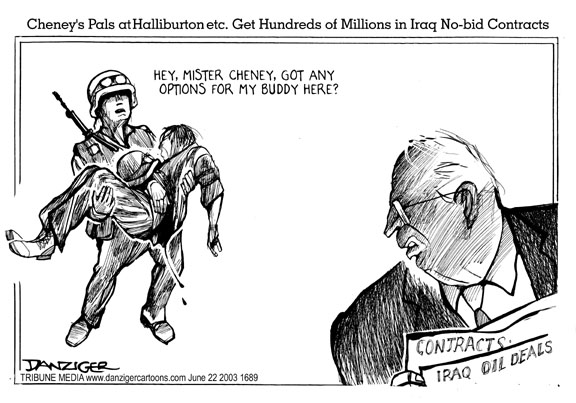
The image “http://www.vvaw.org/gallery/images/fall03photos/cheney-halliburton.jpg” cannot be displayed, because it contains errors.

Thursday, March 20, 2008

Overheard on a Salt Marsh

Nymph, nymph, what are your beads?

Green glass, goblin. Why do you stare at them?

Give them me.
No.

Give them me. Give them me.
No.

Then I will howl all night in the reeds,
Lie in the mud and howl for them.

Goblin, why do you love them so?

They are better than stars or water,
Better than voices of winds that sing,
Better than any man's fair daughter,
Your green glass beads on a silver ring.

Hush, I stole them out of the moon.

Give me your beads, I want them.
No.

I will howl in the deep lagoon
For your green glass beads, I love them so.
Give them me. Give them.
No.

The Brooding Heron artwork you see at the blog is by the wonderful Jackie Morrie, who has worked on the lovely Discworld Calendar and other projects of note. You can see her painting of Sam Vimes and baby Sam here. Her latest book is titled The Snow Leopard

Serendipity:

I came across this review of a new film titled Unforseen when trolling the net for nature poems:

The subject is land development - specifically, what 30 years of profit-bent private sector building has done to Austin, Texas. It's a topic of crucial interest to almost every American town, village, and city, and it inflames passions on both sides....The film's case against overdevelopment needs to be, and could be, aggressive, airtight. It should play to the unconverted. Instead, "The Unforeseen" gives us . . . poetry.


I disagree. Poetry speaks to both heart and mind; it is only in the joining of these two forces that complex problems can be resolved. This is from the poem Santa Clara Valley

What had been foreseen was the coming of the Stranger with Money
All that had been before had been destroyed: the salt marsh
of unremembered time, the remembered homestead, orchard and pasture.

Indeed. I know this place well. It was once called the Valley of Heart's Delight. No one calls it that anymore.

As Robert Redford observes, you can't solve problems unless people are moved and inspired.

Like the goblin in the poem above, we humans are too often willing to trade what's irreplaceable and immensely dear for what's immediate, shiny and cheap.


How very poor that makes us.

Sia

First Poem: Overheard on a Salt Marsh by Harold Monroe