Showing posts with label climate change. Show all posts

Monday, November 17, 2008

Fire Season: The California Fire Season Is Now 12 Months Long


My thoughts today are with friends in California, those who have evacuated from the fires and those who might still have to do so. (1)

What's Been Lost:

It's funny how different people think about these things. I've been wondering how many horses got out, and another concern has been for the many cats and dogs that roam trailer parks like the ones that recently burned down. These animals that live in trailer parks are sometimes pets, sometimes feral and sometimes held, as t'wer, in common, and they are thought of last in such situations, if at all. (As far as we know, there has not yet been a loss of human life - fingers crossed). Meanwhile, a dear friend and art lover is mourning all of the art, antiques and old furniture that has been lost in the lovely homes that burned in Montecito. These, too, are irreplaceable.

As the famous Northern Exposure episode once asked, "What do you save, the cat or the Rembrandt?"

Why Are These Fires So Bad?

Some of the issues here involve building materials and defensible space. This "perfect firestorm" was also created by climate change, specifically, the famous Santa Anna winds which came in this year at hurricane force (something rarely seen during the 32 years I lived in that region but which are becoming more and more common) coupled with an on-going drought and insanely stupid housing developments that sit far too close to wild lands. All this means that worse fires could yet be on the way: Jeremy Jacquot writes:

Parched grasses, when combined with warmer temperatures and strong winds, make for ideal combustion material. Indeed, according to a study published in Science in 2006, the number of wildfires since 1986 has quadrupled, and the area of forest burned has sextupled (when compared to the period between 1970 and 1986) -- the direct result, the authors say, of a spate of longer, warmer summers. Using a data set of past wildfire occurrences in the western United States, they calculated that the length of the active fire season has lengthened by 78 days and that the average burn duration of major fires increased from about 7.5 to 37.1 days.

......Though the future risk of wildfires may fluctuate as a function of a region's moisture, terrain and fuel supply -- indeed, a recent study published in Climatic Change predicted that wildfires could become more frequent in Northern California and less frequent in Southern California because of their differing topography and hydrology -- the larger problem, many experts warn, is that more and more cities are abutting wildland areas. This makes it harder for fire departments to commit sufficient resources toward both protecting homes and combating fires, something that became immediately apparent this weekend. (Of course, it wouldn't hurt if the Governator actually implemented all those fire reforms from the 2003 fires he has touted.)

A UC Berkeley report released this past week estimated the combined effects of climate change -- sea level rise, wildfires and other extreme weather patterns -- could cost the state $300 million to $3.9 billion a year (a figure that seems fairly reasonable in the wake of last week's destruction); the authors believe $2.5 trillion in real estate assets could be at risk. Even if the costs of mitigation prove equally high, it is difficult to argue with the authors' argument that the worst thing we could do now is to not do anything about climate change.


Concerns About Chemicals

Right now there are concerns about the chemicals we use to fight fires and their effect on the environment. The NYT writes:

Retardant, whether released by small planes that sweep low through smoky canyons or by DC-10s in 12,000-gallon bursts, has become an increasingly common tool for fighting wildfires. Yet while many residents praise — and even demand — the use of retardant to protect their homes and neighborhoods, the potent mix of chemicals in the most common type can leave scars of its own, hurting watersheds and the fish and other animals that live in them.

Increasing concerns over retardant are prompting opposition to its use in certain situations and further stirring the debate in the West over how much is too much when it comes to fighting wildfires.

“It’s fairly well known that it’s toxic to aquatic organisms, to fish,” said Sue Husari, the fire management officer for the Pacific West region of the National Park Service. “In a lot of cases, we prefer to limit its use, but it’s definitely one of the tools we use.”

Getting the News:

The LA Times has some of the best coverage, while Mashable lists 10 Different Ways to follow this news, including updates from FEMA and local maps, while blogging English Don Mary Beard offers a personal account.

Sia

Further Information: Keeping Your Pet Safe: This comes from Portland Pets:

The AKC's tips for protecting you and your dog in case of fire:

  • Be sure that your dog and other pets are part of an organized evacuation plan. Rehearse the plan with your family, including your dog.
  • Have a dog disaster kit with: your dog's kibble and treats, water, vaccination records and medications, emergency contact information including your vet's number, a favorite toy and an extra leash and collar with your dog's identification.
  • Listen to your dog! Canines have the ability to smell smoke before humans. If your dog is acting strangely, look into it and be prepared to gather your family and follow your evacuation plan.
  • Being confined their pens is the #1 reason dogs perish in fires. Be sure your fire safety plan accounts for crated dogs.
  • Research canine organizations in your area ahead of time, so you know where to board your dog in case of emergency.
  • Consider installing a dog door leading outside so that an endangered dog has a chance to escape on its own.
  • Increase your dog's chances of rescue by putting a sticker on your front door and windows on your fire escape reading, "DOG INSIDE. IN CASE OF EMERGENCY, PLEASE RESCUE."
  • When not at home, keep your dog on the ground floor (if you can) so it will be easier to rescue.
  • Give a key to a trusted neighbor, and make sure they know where the dog might be located within the house, so they can inform firefighters.
  • If your dog was in a smoke-filled building, or you smell smoke on its fur, take it to your veterinarian. Toxic fumes can be deadly.
  • Microchip your dog and enroll in the AKC Companion Animal Recovery database (AKC-CAR). If your dog gets lost during a fire, a microchip will increase your chances of being reunited. For more information, visit www.akccar.org.
  • Be sure to have working smoke detectors on every level of your home and near bedrooms, and keep hallways and home exits free of clutter.

Alert firefighters about your dog.

A well-trained dog is also more likely to respond to commands, so that may be another good reason to keep working with your dog on his or her training.


Endnotes:

(1) I am also holding the firefighters in my heart, including the husband of one dear friend who was called out from his fire station in Northern California to help fight the fires in Southern California. She is home, taking care of children and waiting for news. Love you, L. & M Hang in there.

Additional Articles:

What Turns Fires Into Disasters?

Photo: from Treehugger.com

Tuesday, September 16, 2008

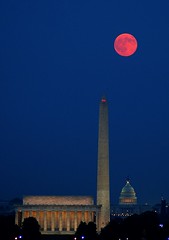
Harvest Moon: For Some, It's A Bad Moon Rising


Harvest Moon rising II
Originally uploaded by philliefan99
If Lady Moon teaches us anything, it is "What goes around, comes around". Right now, some cosmic chickens are coming home to roost, and it isn't even October yet. I don't know about you, but I'm in no mood for any more surprises.

After checking both the market and the polls today, I am reminded of the ancient Chinese curse: "May you live in interesting times".

I see the bad moon arising.

I see trouble on the way.
I see earthquakes and lightnin.
I see bad times today.

Chorus:
Dont go around tonight,
Well, its bound to take your life,
Theres a bad moon on the rise.

I hear hurricanes ablowing.
I know the end is coming soon.
I fear rivers over flowing.
I hear the voice of rage and ruin.

Hope you got your things together.
Hope you are quite prepared to die.
Looks like were in for nasty weather.
One eye is taken for an eye.

Hang in there.

My thoughts today are with the people and animals affected by Hurrican Ike. Let's not forget that they still need our help.

Sia

Additional Articles:

The Motley Fool on the credit crisis

Global Warming, Retiring Boomers and Who's To Pay The Damages
Excerpt:
It’s not only flooding that has insurers worried. It’s wind damage, mud slides, and coastal erosion. We’re talking tens of billions of dollars of potential damage. Right now there’s only a patchwork of state insurance funds which may not be up to the task, coupled with federal flood insurance that already went $17 billion into the hole after Katrina.

...To make matters worse, developers are planning even more homes and commercial properties in vulnerable areas. You see, 77 million boomers will be retiring over the next fifteen to twenty years, and many want to go to coastal areas where the weather is milder and the beaches beautiful – Florida, the Carolinas, coastal Virginia, Cape Cod.


Harvest Moon:

Skywatch reminds us to:

Gaze east tonight for the fully illuminated moon to rise...The moon will glow a deep orange and will change into a bright orb of cream-colored light as it slowly rises higher and arcs across the night sky.

When the moon is low and just above the horizon we are looking at it through many layers of the Earth's atmosphere. These layers bend and refract the lunar light we see into burnished or deep bronze displays of color.

Photo: Harvest Moon over D.C. - Thanks to Philliefan99 for the photo

Sunday, March 16, 2008

Hundreds strip naked on glacier

From We'Moon:

Protest Is Good For You

Protesting is not complaining, nor is it sending out negative messages. Pro means "for," "in favor of." "Test means, "to speak," as in testify and testimony. So protest actually means, "to speak for." Protest is a completely positive endeavor.

The Media like to portray peace, environment, and human and animal rights protesters as a fringe element of whining malcontents teetering on the margins of proper society. The truth is that those who step forward to speak their mind are happier and healthier folks than most.

- Mamma Donna Henes

This video shows us one creative way in which people are protesting.

Naked or not, speak.

Sia

Friday, August 03, 2007

Is Environmentalism Our New Religion?: Our environmental harvest and how it effects ethics, ecology and climate change


Violence is almost always a function of diminished imagination. With our respect for the earth and our tradition of universal sympathy, (we) might well model a new way of being in the world. An organic faith that brings together the simple truths of the oldest religions with the complex realities of the brave new world - this is really what contemporary earth-centered faith is about.
- from Sermons by the Rev. Roberta Finkelstein


Is Environmentalism the New Religion?


Joseph Bream at The National Post (Canada) writes:

Forty years ago, shortly after Rachel Carson launched modern environmentalism by publishing Silent Spring, leading to the first Earth Day in 1970, a Princeton history professor named Lynn White wrote a seminal essay called "The Historical Roots of our Ecological Crisis."

"By destroying pagan animism [the belief that natural objects have souls], Christianity made it possible to exploit nature in a mood of indifference to the feelings of natural objects," he wrote in a 1967 issue of . "Since the roots of our trouble are so largely religious, the remedy must also be essentially religious, whether we call it that or not." It was a prescient claim. In a 2003 speech in San Francisco, best-selling author Michael Crichton was among the first to explicitly close the circle, calling modern environmentalism "the religion of choice for urban atheists ... a perfect 21st century re-mapping of traditional JudeoChristian beliefs and myths."

Today, the popularity of British author James Lovelock's Gaia Hypothesis - that the Earth itself functions as a living organism - confirms the return of a sort of idolatrous animism, a religion of nature. The recent IPCC report, and a week's worth of turgid headlines, did not create this faith, but certainly made it more evident.

Everything Old is New Again: Any Pagan can tell you that linking nature, spirituality and our own well being within one world view is not exactly new. Demeter is one ancient aspect of our link to and reliance on the earth. So is Ceres. As Hecate notes:

Lammastide seems a good time to remember this agricultural Goddess who, although a benefactor of humankind, was willing to revoke her benificence when her daughter was mistreated.

Yea, verily.

Demeter was sometimes venerated as a mare. My Celtic ancestors would have known Her as Epona.

But let us not idealize our Pagan ancestors too much. They may have worshiped nature, but that does not mean that they lived in complete harmony with their environment. For more on this subject read: Pan's Travail: Environmental Problems of the Ancient Greeks and Romans (Ancient Society and History). In this book author J. Donald Hughes examines the environmental history of the classical period and argues that the decline of ancient civilizations resulted in part from exploitation of the natural world.

Sound familiar?

What's Next? The Shape of the Next Religion:

Are we changing spiritually ? And if so, what's next and what does that mean for the planet? For more on this subject read The Shape of the Next Religion by Douglas Mudar.

Art & Spirit

As they so often do, artists lead the way when a culture is changing. They know it before we do. I recommend this book to those who are interested in the links between artistic expression and concern for the earth:

Shards & Circles: Artistic Adventures in Spirit and Ecology

The artist/author is Daniel Dancer. As his website states:

Dancer is the founder and director of the ZeroCircles: an ongoing national environmental art project designed to help end commercial extraction on public lands. "From the megalithic stone rings of Britain to the medicine wheels of Native America, humans have built circles to celebrate their connection to Earth. Circles are zeroes as well, and today it is the zero we must employ to help protect the ecosystems which sustain us: zero pollution, zero waste, zero population growth.."

Environmental Art:

Check out the wonderful Green Museum for more images of environmental art.

This online museum emerged from the artist's experiences making such art and it is designed as a a giant collaborative art making tool. It's an inspiring place to visit.

Where Do We Go From Here?

Can we do it? Can we stop this insane cultural march over the cliff? Or is our species, like the Congo's Gorillas, far more threatened by habitat destruction, greed, and violence then we ever realized? The news paints a bleak picture, but I was heartened to read a recent interview by Fareed Zakaria with Amory Lovins on energy's (and our) future. I will leave you with their thoughts on A Cure for Oil Addicts and suggest you also check out this page on the brave men and women who risk their lives protecting wildlife in Africa. I would also direct you a website about a very powerful, very modern Demeter, a woman who's life was a force for good: Rachael Carson.

Don't despair. Earth Based Spirituality is growing in power and influence as is a global awareness that we need to change our way of living and wasting if we want to survive. In fact, these two things are closely allied. There is much we can do, but time is running out. Get involved.

Blessings to you and yours at the harvest,

Sia

Related Links:

Persephone & Demeter by the brilliant (and greatly missed) Susan Seddon Boulet

A modern vision of Demeter by Abdul Mati Klarwein

Related Posts:

Gaia's Guardians

Off the Shelf:

Pagan Visions For A Sustainable Future by Ly de Angeles, Emma Restall Or, and Thom van Dooran

Faith in Nature: Environmentalism As Religious Quest (Weyerhaeuser Environmental Books) by Thomas R. Dunlap

Nature Religion in America: From the Algonkian Indians to the New Age (Chicago History of American Religion) by Catherine L. Albanese

Ecoshamanism: Sacred Practices of Unity, Power and Earth Healing by James Endredy

As always, links, books, opinions and articles at this blog are offered as food for thought. Take what you need, and leave the rest. SV.

Art: Demeter Relief: Copy of the one in the Versailles Municipal Library, France. 18th century. It is available at Rainbowcrystal.com