Showing posts with label Epona. Show all posts

Thursday, June 18, 2009

Summer Solstice: Ancient & Modern Celebrations


‘Before the gods that made the gods
Had seen their sunrise pass,
The White Horse of the White Horse Vale
Was cut out of the grass.’


G.K Chesterton, 1911

Blessings of the coming Summer Solstice to you and yours. I hope you have fun welcoming in the day. I know I will.

(from 2008 - Reposted in honor of Pagan Values Month)


The Religious Tolerance website reminds us that this is
day celebrated by people of many faiths and none. As such, it's one of my favorite holidays.

I always like to find a slightly different take on these well known holidays. Here are two such: Five Petal Rose wrote an interesting post on the Summer Solstice as a Holiday of Fire and Water
while Blue Roebuck offers us a nice mix of Sun Goddesses as a means to reclaim the power of women.

Today I would like to share a recent story about the Giant of Dorset.

Many believe the figure is a symbol of ancient spirituality and fertility and he has been used to advertise products as diverse as condoms, jeans and bicycles.

During WWII, the giant was disguised to prevent the Germans using him as an aerial landmark.
This area of England is blessed with abundant wildlife close to the giant (natch) and these insects, flowers, animals and birds are being studied and protected by the National Trust.

Of all the chalk figures, my personal favorite is the
White Horse of Uffington. Note to horse lovers, the summer solstice is also known as the Feast of Eopna, who is the great Horse Goddess of the ancient Guals and is thus connected to Celtic tradition. Here are some photos from Loxley Abby of one such feast. On Macknac Island in Michigan this is also a time when the animals are blessed. The Gift Horse Gallery has a nice write up on Epona and a Pagan blogger named Anita offers a mantra for this day.

Speaking of animals, check out Take Your Dog To Work Day.

"Heel, girl. Mamma's gonna get the leash...."


Sia

Art: Epona by Joanna Barnum

Endnotes: Some Solstice Myths and Facts:


The StarDate site tells us that:

There are two solstices each year. The winter solstice, the shortest day of the year, occurs when the sun appears farthest south in the sky. The summer solstice, the longest day of the year, occurs when the sun appears farthest in the north. Egyptians were especially interested in the summer solstice because it marked the beginning of the Nile's flood season. Accurately predicting the floods was of such vital importance that the appearance of Sirius, which occurs around the time of the summer solstice, was recognized as the beginning of the Egyptian new year.
Water is Life:

Nabta: Circle in the Sand (also from StarDate)

To the people of ancient Nabta, in the desert of southern Egypt, the summer solstice meant life. Soon after the Sun reached the northernmost point in its annual trek across the sky, monsoons brought precious rainfall. Not much rain, mind you — no more than four to eight inches a year, about the equivalent of the annual rainfall in Las Vegas or Phoenix. But for a few weeks, water filled shallow desert basins. Grass grew along the banks, providing fodder for cattle, and wells filled with enough water to sustain small nomadic tribes for the entire year. To help them predict and commemorate this life-giving event, the people at Nabta built an observatory — a 12-foot (4-meter) circle of flat stones, with four pairs of taller stones aligned opposite each other. Two pair provided a "window" on the solstice sunrise, while the other two aligned on an almost-perfect north-south axis
Illustration: From the StarDate site.

Ancient Alignments: Scientific American published a fasinating article some years ago on the research being done at Nabta, an site which contains the world's oldest astronomical observatory:

When the stones were erected, the area received enough rain in the summer monsoon for temporary lakes, called playa, to form. The site, built on the shore of one such lake. Radiocarbon dating indicates that Neolithic herders began coming to Nabta about 10,000 years ago. It was used periodically by nomads until about 4,800 years ago, when the monsoon moved southwest and the area again became arid.

At the height of its human occupation--about 6,000 years ago--Nabta supported well-established communities. One village consisted of 18 houses served by deep wells. Beneath the surface slabs of the largest megalithic structure was a sculptured rock resembling a standing cow. The team also excavated several cattle burials at Nabta, including an articulated skeleton buried in a roofed, clay-lined chamber. The late Neolithic occupants apparently used cattle in their rituals just as the African Massai do today, says Malville.

The Goddess Hathor is closely linked to the solstice. You might enjoy Solstice at Abu Simbel by Graham Raith at Two Camels. His post contains a very good description of a temple dedicated to the Goddess Hathor (note the cattle link again) & Ra:

At the solstices, twice a year, the dawn sunlight is aligned to light the entire length of the temple, lighting up three of the four statues, but never touching that of Ptah, the god of darkness.

If this "miracle of the sun" is the first miracle of Abu Simbel, the saving of the temples is the second. The building of the High Dam at Aswan meant that the original site would be flooded, and the temples lost under the waters of Lake Nasser. An international rescue effort was mounted, and the temples cut onto blocks and removed to their present, higher location, set into a concrete supporting bowl, and retaining the original precise orientation to preserve the "miracle of the sun".


Friday, August 03, 2007

Is Environmentalism Our New Religion?: Our environmental harvest and how it effects ethics, ecology and climate change


Violence is almost always a function of diminished imagination. With our respect for the earth and our tradition of universal sympathy, (we) might well model a new way of being in the world. An organic faith that brings together the simple truths of the oldest religions with the complex realities of the brave new world - this is really what contemporary earth-centered faith is about.
- from Sermons by the Rev. Roberta Finkelstein


Is Environmentalism the New Religion?


Joseph Bream at The National Post (Canada) writes:

Forty years ago, shortly after Rachel Carson launched modern environmentalism by publishing Silent Spring, leading to the first Earth Day in 1970, a Princeton history professor named Lynn White wrote a seminal essay called "The Historical Roots of our Ecological Crisis."

"By destroying pagan animism [the belief that natural objects have souls], Christianity made it possible to exploit nature in a mood of indifference to the feelings of natural objects," he wrote in a 1967 issue of . "Since the roots of our trouble are so largely religious, the remedy must also be essentially religious, whether we call it that or not." It was a prescient claim. In a 2003 speech in San Francisco, best-selling author Michael Crichton was among the first to explicitly close the circle, calling modern environmentalism "the religion of choice for urban atheists ... a perfect 21st century re-mapping of traditional JudeoChristian beliefs and myths."

Today, the popularity of British author James Lovelock's Gaia Hypothesis - that the Earth itself functions as a living organism - confirms the return of a sort of idolatrous animism, a religion of nature. The recent IPCC report, and a week's worth of turgid headlines, did not create this faith, but certainly made it more evident.

Everything Old is New Again: Any Pagan can tell you that linking nature, spirituality and our own well being within one world view is not exactly new. Demeter is one ancient aspect of our link to and reliance on the earth. So is Ceres. As Hecate notes:

Lammastide seems a good time to remember this agricultural Goddess who, although a benefactor of humankind, was willing to revoke her benificence when her daughter was mistreated.

Yea, verily.

Demeter was sometimes venerated as a mare. My Celtic ancestors would have known Her as Epona.

But let us not idealize our Pagan ancestors too much. They may have worshiped nature, but that does not mean that they lived in complete harmony with their environment. For more on this subject read: Pan's Travail: Environmental Problems of the Ancient Greeks and Romans (Ancient Society and History). In this book author J. Donald Hughes examines the environmental history of the classical period and argues that the decline of ancient civilizations resulted in part from exploitation of the natural world.

Sound familiar?

What's Next? The Shape of the Next Religion:

Are we changing spiritually ? And if so, what's next and what does that mean for the planet? For more on this subject read The Shape of the Next Religion by Douglas Mudar.

Art & Spirit

As they so often do, artists lead the way when a culture is changing. They know it before we do. I recommend this book to those who are interested in the links between artistic expression and concern for the earth:

Shards & Circles: Artistic Adventures in Spirit and Ecology

The artist/author is Daniel Dancer. As his website states:

Dancer is the founder and director of the ZeroCircles: an ongoing national environmental art project designed to help end commercial extraction on public lands. "From the megalithic stone rings of Britain to the medicine wheels of Native America, humans have built circles to celebrate their connection to Earth. Circles are zeroes as well, and today it is the zero we must employ to help protect the ecosystems which sustain us: zero pollution, zero waste, zero population growth.."

Environmental Art:

Check out the wonderful Green Museum for more images of environmental art.

This online museum emerged from the artist's experiences making such art and it is designed as a a giant collaborative art making tool. It's an inspiring place to visit.

Where Do We Go From Here?

Can we do it? Can we stop this insane cultural march over the cliff? Or is our species, like the Congo's Gorillas, far more threatened by habitat destruction, greed, and violence then we ever realized? The news paints a bleak picture, but I was heartened to read a recent interview by Fareed Zakaria with Amory Lovins on energy's (and our) future. I will leave you with their thoughts on A Cure for Oil Addicts and suggest you also check out this page on the brave men and women who risk their lives protecting wildlife in Africa. I would also direct you a website about a very powerful, very modern Demeter, a woman who's life was a force for good: Rachael Carson.

Don't despair. Earth Based Spirituality is growing in power and influence as is a global awareness that we need to change our way of living and wasting if we want to survive. In fact, these two things are closely allied. There is much we can do, but time is running out. Get involved.

Blessings to you and yours at the harvest,

Sia

Related Links:

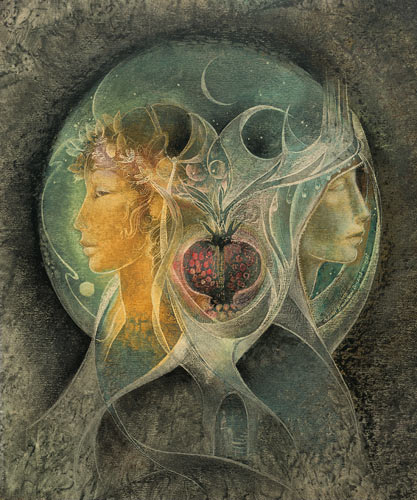
Persephone & Demeter by the brilliant (and greatly missed) Susan Seddon Boulet

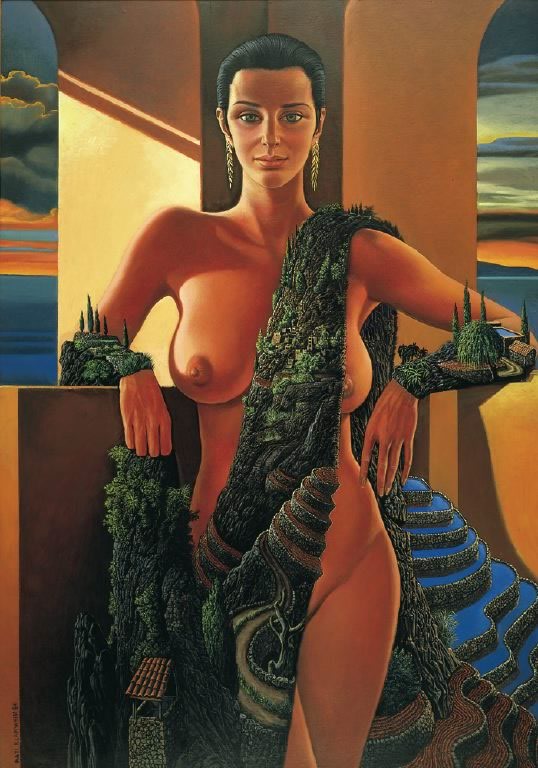
A modern vision of Demeter by Abdul Mati Klarwein

Related Posts:

Gaia's Guardians

Off the Shelf:

Pagan Visions For A Sustainable Future by Ly de Angeles, Emma Restall Or, and Thom van Dooran

Faith in Nature: Environmentalism As Religious Quest (Weyerhaeuser Environmental Books) by Thomas R. Dunlap

Nature Religion in America: From the Algonkian Indians to the New Age (Chicago History of American Religion) by Catherine L. Albanese

Ecoshamanism: Sacred Practices of Unity, Power and Earth Healing by James Endredy

As always, links, books, opinions and articles at this blog are offered as food for thought. Take what you need, and leave the rest. SV.

Art: Demeter Relief: Copy of the one in the Versailles Municipal Library, France. 18th century. It is available at Rainbowcrystal.com