Showing posts with label Essays. Show all posts

Monday, November 24, 2008

This American Life: Music


This one goes out to those among us who were in their high school band, orchestra or choral group. You know who you are....

Last Sunday, This American Life put on one of the best programs I've ever heard them give. Called Music, it featured three radio essays by authors David Sedaris, Sarah Vowell and Anne Lamott. Sarah's essay - where she tells us all the things she learned that had nothing to do with music - was my favorite.

Listen.....

Sia

Endnotes:

(1) A music critic who writes both comedy and history, Sarah is also the author of Assissination Vacation and The Wordy Shipmates. She is also well known as the voice of Violet Parr in the brilliant animated film, The Incredibles.

Here is video of Sarah on The Daily Show, talking about her new book on what she calls "those elitist Puritan Jesus Freaks". It's very funny - enjoy.

More Links:

Just cause - Elizabethan & Tudor Music

Image: from Strange Guitars


Monday, September 24, 2007

Hey 19


I sometimes get letters from people who read my articles at Vox. I got one such today. It came from a thoughtful young person who related to comments about the Lost Children among us. (1)

Dear Sia,

I guess I'm not sure what I ultimately want to say. I know that I was touched by the things you said in your article I just read and there are parts that seem to ring true....there is so much in Pagan beliefs that I want to strive to become part of, but can't. I know that right now, my life is way out of balance and I fight to create some order out of the chaos and better myself......I still find myself at a loss. I'm sure you get tons of things from people talking about losing their way, and I know that there is no easy solution to these problems. I guess what I ultimately want to ask, is how you became an adult Pagan, that better person that you wanted to be? I'm 19 and I find that I seem to drift, alone, unsure of how to find my place in the world. Where does one start? Where do you find that platform, that allows you to begin to understand yourself and at the same time give yourself the power to make the changes you desire?

Thx

---------

I'm always humbled by such a letter. I do my best to answer these, keeping in mind that my answers are my answers and may not suit their path at all. I'm not some all-knowing oracle, I'm only one other person on the path. At most, I may be a bit further along the road, and can offer some ideas of what the trail is like.

My response to this person is below. If you have any wisdom to add, please do so in the comments section.

----------

Dear 19

You are very right, we get a lot of questions like this. I'm no guru, as you know, however, I have felt these feelings, as well. I, too, felt lost and alone at 19. It is a time of great discovery and great challenges. I can only tell you what I have learned on my own journey. Take what you need and leave the rest.

First, I'd like you to know that you are not alone. In my experience, Pagan practice is very much like a garden, or, if you are technically inclined, much like a computer program. The code needs to be clear, and the ground fertile; otherwise nothing of worth will come out of it. So, you have begun your path in the right way; you've decided to clear the ground and check the code before you go further. At 19, few of us know who we are and we still have life tools to put into our tool box. That is your task right now. No one expects you to be perfect - all we ask is that you stay as conscious as you can and keep learning.

Let me put it another way: This path is not about command and control but about connection and communion. The sacred cannot speak to us, if our heads and hearts are polluted by noise and pain and trash. So the trick is to release what is unhealthy in our lives and embrace what works for us. That is as true for me at 50 as is it for anyone.

There are various ways to do that.

Here is one way - You are welcome here if you wish :-)

Few of us get out of childhood and our teenage years without some pain and hurt. Healing this pain and hurt and finding out who we really are is our job in our 20's. At this age, you are an Explorer. Some days you will explore the world, and some days you will marvel at other people and new ideas and some days you will need to explore your own past and decide who and what you want to be. To start, I would recommend two books:

Bradshaw On: The Family

and

Life and How to Survive It

Right now, you are a product of your family, their rules and their teachings. In order to become the person we want to be, we need to

* Take stock of what they taught us (both verbally and by example)

* Heal what hurts we got from school, growing up, family and cultural dysfunction


* See if we need to heal from depression, ADD, addiction, abuse or other issues and

* Decide which friends and communities are good for us and which are not, and

* Keep what we like and can use, bless and release the rest, and move forward.

As you can imagine this takes a while. In fact, it will take up most of your 20's. It can be tough, but it is also a grand adventure, full of surprises, gifts and grace. If you are asking the right questions now, and I believe that you are, you are ahead of many of your peers, and will do very well indeed :-) The trick is not to be afraid of the answers.

My I suggest some further reading, as well? If you go the blog, you will find a list of articles I wrote for The Witches Voice. I have written two that will serve you right now titled The Shadow Knows and The Bard and the Poser. There are others listed there, as well, including Pagans and Self Actulizations by Rev. Wren Walker.

This path isn't about belief - it's about experiencing the joy and wonder that is there for you. The more you heal yourself, the more you will be open to that joy and wonder and the clearer your path will be. As the Techno-wizards say, "Garbage in, garbage out". So the question is, what is in your life that is getting between you and your highest good? Is it depression? Guilt and shame? Drugs or alcohol? Dysfunctional people? Past Abuse? Whatever it is, you will find that you move forward on your spiritual path as you heal yourself.

Paganism and healing are lifelong journeys. Both are worth it.

Hang in there.

Sia


From The Wisdom Keepers To The Next Generation:

What The Grandmother & Attorney Said

What the Songwriter & Mother Said

Links:

List of Generations at Wikipedia

Why 50somethings Live Like 20somethings

Related Posts:

Dysfunctional and Healthy Behavior and the Pagan Scene

Photo: Portrait of Lydia Pinkham by Rune T (Oslo, Norway)

Endnotes:

The section on The Lost Children comes from the essay Healthy Pagan Groups and Individuals and reads as follows:

THE LOST CHILDREN:

My father says that almost the whole world is asleep.
Everybody you know. Everybody you see. Everybody you talk to.
He says that only a few people are awake, and
they live in a state of constant, total amazement
- from Joe and the Volcano

One question that often comes up among Pagans is this: We know that everyone has baggage and that every group has their share of dysfunctional people, but why do Pagan groups have so darn many of them?

I have two answers to that. First, there are a lot more happy, functional Pagans out there than we realize. (I'll discuss this point more fully later on in this essay.) Secondly, we Pagans pride ourselves, quite rightly, on being inclusive, and any path which teaches tolerance and acceptance is going to attract a wide range of people at various stages of health, including those my colleague Ashli refers to as The Lost Children.

The problem is not that we are accepting, the problem is that many Pagans haven't yet learned that accepting an individual and accepting bad behavior from that individual are two different things. It's important to know that we can love the one, and not put up with the other. This also requires that our teachers, organizers, and circle leaders work to establish healthy boundaries and standards, something that many of us don't know how to do, or fear doing.

Here is another mystery: The Lost Children are not a "Them", they are Us, and we are a very mixed bag. (3) The Lost Children are a part of that tribe of Outsiders I mentioned earlier. Outsiders are a group that includes most of the great writers, artists, leaders, scientists, and thinkers in human history. They are those who don't "fit" into their culture's rigid little mold.

An Outsider may be hiding in plain sight. They may look like a part of the dominant culture, but they do not think the same thoughts, nor are they caught up in the cultural trance. Conversely, they may be someone living a very alternative lifestyle in a very public way. However they appear, Outsiders are those who question both authority and learned helplessness.

Among the Outsiders, the Lost Children in particular are looking for a place to call home. Many have been rejected by other groups, religions, or scenes, and then they come here, looking for acceptance. As Ashli points out, the situation in modern Paganism is not so much that of a round peg trying to fit into a square hole, it is more like a variety of shapes coming into a place where shape doesn't matter at all. That's fine as far as it goes, but it becomes a problem for us when no standards of conduct are ever applied, no matter how healthy or necessary these might be.

I say this with deep sadness: Our culture has failed our Lost Children. Their parents have failed them. The schools have failed them, their peers have failed them, and, Goddess help us, we have failed them. They come to us, looking for meaning and True Tribe and what do we give them? Poses and platitudes. They come to us with a hole in their soul because they are lacking the unconditional love, guidance, and stability they deserved but never got as children, and we give them Witch Wars and yet more dysfunction. Very often they will try to fill this hole with alcohol, drugs, unhappy sexual encounters, food, and whatever else comes to hand, and we offer them no understanding of what the hole really is or how to heal it. They come to us seeking acceptance and a safe place to practice their path, and we allow predators and abusers into their circles. Some day, we will answer for this.

The Lost Children are often so because they were raised with either too little healthy parenting or far too much harsh discipline by adults who were deeply unhappy themselves. Sometimes they fear to grow up because they believe it means becoming like "them". Sometimes they grew up far too fast and have no experience of joy, play or wonder.

The Lost Children are not lost because they are somehow bad or wrong. They are lost because they were never valued as they deserved, or because they never got the guidance they needed or because they were abused or because they had to try and cope with mental, physical, emotional or spiritual challenges all on their own. They come to us, instinctively knowing that Paganism holds healing at it's core, and when we don't help them they can morph from being Lost Children to Problem Children in a heartbeat.

A Pagan gal named Tree wrote this to me just recently:

I've been torn about recommitting to the Goddess and the Earth, because I thought I'd be lonely. . . A couple of weeks ago I was wandering around despondently thinking, "Where on Earth am I going to find Pagans who want do the tough work of growing up?"

What do the Lost Children really need? They need support as they walk a very challenging path. They need trustworthy companions, and connection. The Lost Children need to be around joyous, free, spiritually mature human beings, who are comfortable with their power and compassionate in their wisdom. They need to be around creative people who are in touch with play, wonder, healthy sexuality, and the divine; people who also know how to work hard, honor their word, and pay the rent. We Pagans claim to honor the divine, wherever we find it, however we understand it. We claim to respect what is sacred, both within and without. In teaching this, we must also teach our people to honor others as they wish to be honored themselves. We must consciously model for our students and circle members what it looks like to be in touch with our Best Selves and the God/ess within. This requires an emotional, mental, and spiritual evolution on the part of all here. It's not easy, but nothing less will do.


Saturday, May 26, 2007

Titles, Schmitles

Off the Shelf:

Composing a Life by Mary Catherine Bateson -
The daughter of Margaret Mead writes about life as an improvisational art form.

Spiritual Mentoring: A Pagan Guide by Judy Harrow -
This guide focuses on spiritual teaching issues within the Pagan community and addresses topics such as good seeker-to-mentor matching, clear communication, religious maturity, and the role of community.

The difference between a flower and a weed
is a judgment

I love this quote. It reminds me that wise Pagans learn to grow where we are planted. At the same time, we each choose the Path that is right for us. We don't let other people do that for us. In other words, we define ourselves.

When people ask me what my Pagan "title" is I don't tell them that I am a High this or Lady that. I tell them I'm a learner. It gets me some odd looks at festivals, but it fits me, it's right for my path.

Some years ago I wrote an essay called Pagan Doers. In there, I said this about titles:

When we do use a title such as "Leader" we have a wyrd way of defining it. A "Leader" at Full Circle is the one you see doing the donkey work.... We think that being in charge of something means that you do the most work of anyone in your group. It means you're the first one to arrive and the last one to leave. You do whatever needs doing. If that means you clean the toilets before an event, then so be it. Don't laugh, I've done that. The closest I've ever gotten to holding a Staff of Office is that toilet brush.

I knew a "titled" Pagan once who had quite the opposite approach. She was so full of herself that she thought her students should stand up whenever she entered a room, even when they were gathered together in a mundane place like a coffee shop. She was very jealous of her perceived prerogatives and status. She was not as concerned with loyalty or ethics, something that became apparent when she skipped town owing a good deal of money to a number of people in the community, many of whom could ill afford the loss. I worry sometimes about our community's need for titles and the extent to which we will worship (bow down to) rather than connect with, the Goddess. As Terry Pratchett has said, "No sooner did Man learn to stand, then he got down on his knees." Speaking for myself, I'd rather face Her, and my brother and sister Pagans, eye to eye. Wouldn't you?

For more on this subject, I recommend reading a wonderful article at Vox by Jenny Shumaker titled Why I'm No Lady.

Is This On The Test?

So if I'm a learner, when do I take the test? The answer is: every day.

Right now, my own test involves choices. Among them: Where do I put my energy and time? Who do I listen to? Who do I counsel? And what do I want in my life's garden five, ten or twenty years from now? There are lots of flowers to choose from, and spring is here; time to get to work.

The Pagan path holds great beauty and meaning. It also holds a great many lessons. Some of these are universal, some are unique to each student. Here's what I know that might be of use to others: The first lesson is that we don't get either beauty or meaning without some hard work. The second lesson is that it's worth it. The third lesson is that we will receive the help we need when we need it. All we need to do it show up, pay attention and tell the truth. Here endth the lesson.

Sia

Wednesday, May 09, 2007

Reclaiming Mother's Day


For those who might be interested:

Beyond Mere Sentiment: Reclaiming Mother's Day.

Excerpt:

The Radical Origins of Mother’s Day:

In an article written for WorkingForChange.com, Gev Parish notes:

Julia Ward Howe called for the establishment of Mother's Day in 1870. Her gesture was intended not as a sentimental tribute to those who bear children, but as a call for women to wage a general strike to end war. (1)

Julia, a poet and suffragist, began her work to honor mothers as a radical act. We tend to forget that mothers are, and always have been, politically and socially active. Throughout history, they have used the wisdom they gained as mothers to think of future generations and work for the good of all. (2)

Real Life Moms:

Motherhood’s a tough gig.

To be a mother is to cry and rage and worry and work till you want to drop. And most women do this without any help from any darn village.

Motherhood is both mind numbing and inspiring, frustrating and fulfilling. It’s a job worth doing and it takes a great deal of strength, wisdom, and self esteem to do it well. The many images of the Great Mother give us a sense of this. Her secret is contained within a paradox of seeming contradictions. She is both and equally, Kuan Yin and Kali, Isis and Morrigan, Aphrodite and Hecate, Lakshmi and Durga, Freya and Ha Hai-i Wuhti. In other, psychologically profound myths, she is portrayed as Medea, who destroyed her children in a fit of rage, and Lysistrata, who organized other mothers, stopped a war and saved two cities in the process. To see only one, sweet side of a mother is to ignore the complex, empowering truth of Her; a truth we can’t afford to miss.

Real mothers sometimes want to punch a wall. Instead they give hugs. They also teach, encourage, praise, and protect, and they do this creatively, day after day, no matter what. No wonder they simplified this holiday – it’s too hard to get all of that in one greeting card....

The Creatrix

Some of us don’t have children (either by choice or by chance) so we honor the Creatrix. The Creatrix is connected to Gaia. She creates her own life as well as great friendships, arts and crafts, loving homes, beauty, peace, prosperity, and opportunities. She empowers friends and family and is, herself, empowered. She cares for others and she protects those who cannot protect themselves. She is a mistress of learning, knowledge, and culture. She has many forms including that of Artemis, Hestia, Athena, and Bridget. She can stand alone or with a partner. It’s her choice. We know her by the blessings that flow from her hand and the ideas that come from her mind and heart. This form of creation is worth knowing and honoring, as well.

[To read the full article, click on the link. The article also contains a bibliography]

-------------------

The artwork that accompanies this article (and is copied above) is called Rhea. It is by Sandra M. Stanton. If you would like to see more of Susan's Goddess art, visit Goddess Myths. A portion of all sales from her prints goes to the Global Fund for Women. This image is used with her permission.

Sia

Saturday, April 28, 2007

Beltane: Old Style & New Style


I sent out Beltane greetings to friends today.

Our own celebrations will begin at sunset on April 30th, and continue on through the time of Old Beltane (1) and a bit beyond. These celebrations include parties, dancing the sun up, rituals, feasts, decorating springs and wells, Morris Dancers, rituals and May Poles. That's Beltane Old Style. Our celebrations also include habitat restoration work, native gardening efforts, raising funds for local charities, food drives, supporting animal rescue groups, and other meaningful work for Mama Gaia and her creatures. That's Beltane New Style.

It is a busy and beautiful time.

Old Style or New Style it's a time for flirting, fun and frolic. Being uppity women, Snakemoon and I both own quote buttons that say Hi, I'm Pagan. Ask Me About My Sex Holiday.

Beltane is also a time to celebrate the Green Man. If you have not already seen it, you may like this old essay of mine titled In Praise Of Pagan Men

This is a time to cherish the earth while we celebrate spring. For example, our Gaia's Guardian's project helps recruit volunteers from among our earthwise friends to work with mainstream, locally based non-profit groups that help both animals and the planet. It's always been important to me to build these kind of links between Pagan volunteers, and their neighborhood community service organizations. It's something I think needs doing. I find it rewarding, as well. (2)

The timing of this Cross Quarter Holiday can be confusing. Here's why:

* Astrological Beltane: Occurs when the sun is at 15 degrees Taurus. (Usually around May 5th).

* Astronomical Beltane: The time when the constellation Pleiades can be seen on the dawn horizon. Our ancestors would have been well aware of changes to the stars that heralded a change in seasons; something most moderns now miss.

* Calendar Beltane - (AKA May Day): This is commonly celebrated on May 1st. However, it is important to note that calender changes made by the Pope Gregory XIII in 1582 moved the date backwards by 11 days in most European countries. Overnight, May 12th became May 1st. (Note: England and American did not adopt the Gregorian calendar until 1752). Thus, the Calendar puts the well known May Day celebrations such as Morris Dancing, May Poles and Fire Festivals, et al, at at a time far earlier than they were previously held. In Medieval and Renaissance times these celebrations took place 11 - 15 days later in the season; at a time when the weather was noticeably warmer and dryer, travel (both by sea and over land) was easier and safer, many more spring flowers bloomed, a larger number of young animals were about and thriving, and it was far more pleasant to be outside.


* Lunar Beltane: Occurs during the first full moon in May.

Many ancient and modern calendars are based on either lunar or lunisolar calendars. Such calenders were/are used by people in Native American, Hebrew, Islamic, Asian, Hindu and Pagan cultures. Many ancients peoples, including the ancient Celts, Egyptians, Africans, Mayans, Hawaiians, and Babylonians, used lunar calendars.

* Solar Beltane - (AKA Cross Quarter Beltane): Beltane is a Cross Quarter Holiday, one that stands halfway between a solstice and an equinox in the Wheel of the Year. It's exact date and time is calculated in relation to the other seasonal holidays ocuring in a 365 day-long solar year. You can check this on sites such as the Archaeoastronomy site.

Here are
Actual dates and times for the Cross Quarter holidays through 2012

* Tribal - (AKA Festive Beltane): Our ancestors often held feasts, faires, and festivals that lasted for many days. (This makes sense when you consider that travel to and from these gatherings could take days. Why travel all that way for a brief event?)
Today, Pagans and others celebrate this holiday over a period of several days, often gathering to meet or do rituals at a time most convenient for their families and/or group.

The Wheel of the Year:


The Wheel of the Year is celebrated by Pagans, Druids, Wiccans and others as a way to honor the past, and be in touch with nature. Please Note: The number of holidays on the Wheel remains constant, but their names and focus may vary according to one's culture and tradition.


More information and links can be found in the footnote #1.

Happy Spring to all here.

Sia


(1) Doug and Sandy Knopf write that our ancestors knew the time of Beltane was near when they saw the rising of the constellation Pleiades on the dawn horizon. The Pleiades are also known as the Seven Sisters and the first born and most beautiful of the Sisters is named Maia. The month of May is named for Maia.

As Mike Nichols notes:


Due to various calendrical changes down through the centuries, the traditional date of Beltane is not the same as its astrological date. This date, like all astronomically determined dates, may vary by a day or two depending on the year. However, it may be calculated easily enough by determining the date on which the sun is at 15 degrees Taurus (usually around May 5th). British Witches often refer to this date as Old Beltane, and folklorists call it Beltane O.S. ('Old Style'). Some Covens prefer to celebrate on the old date and, at the very least, it gives one options.... This may also be a consideration for Covens that need to organize activities around the week-end.

Lunar Beltane occurs on the first full moon in May. Mark McNutt notes that

Pagans speak of Lunar Beltane, which is the time of the Full Moon in the middle of Spring, always a Moon in Scorpio which implies the mood of sexual fertility and balanced with the sensuality of Taurus. This is why it is such a Bel -time. The ritual of Beltane celebrates life coming into full fertility in the garden and in our own beings. Life, death, and sexuality are transformative partners in the walk of life.

Druid Richard Eaton believes that Beltane is not so much a sexual time in the Wheel of the Year but a sacred fertility festival celebrating birth.

(2) While living in Northern California, my husband and I developed an online Earthwise Community calendar for that state that was, I believe, unique, in part because it supported the view that Pagans are people who walk between worlds. We list social and cultural events on our calendar as well as arts and crafts postings, gardening, musical and family-friendly events, as well as nature hikes and camp outs. These are listed right alongside rituals, Pagan classes and drumming circles. After all, we Pagans have lives. I enjoyed doing that (as time consuming as it was) but it is something I had to give up when we moved to a new state. I notice with a great deal of quiet pride that other people in the earthwise community are doing this sort of broad-focused networking in their communities and using the new media to great effect. Good on you, folks.

------------

Off the Shelf:

Beltane: Springtime Rituals, Lore and Celebration by Raven Grimassi

Wheel Of The Year: Living the Magical Life by Paulene Campenelli

The Witches' Sabbats by Mike Nichols.

Green Man: Tales of the Mythic Forest: Terri Windling (Editor) A book of stories a
bout the Green Man and the Green Woman.

The Green Man: Spirit of Nature by John Mathews.

Green Magic: The Sacred Connections to Nature by Ann Moura

Lord of Light and Shadow: The Many Faces of the God by Dj Conway

King, Warrior, Magician, Lover: Rediscovering the Archetypes of the Mature Masculine by Robert Moore and Douglas Gillette

Save Our Planet: 750 Everyday Ways You Can Help Clean Up the Earth/25th Anniversary Edition by Diane Maceachern

For Parents:

Circle Round and Sing by Anne Hill

50 Things Kids Can Do To Save the Earth by The Earthworks Group

Artwork: This image is by the brillent Mr. Brian Froud. Brian was kind enough to let us use several of his images for our Fairy-themed Witches Ball in 2001. He also donated several prints for our silent auction. This ball was a charity fundraiser for our local Humane Society and over 600 people attended that year. Brian lives in the UK, and he was scheduled to tour the U.S. and to attend our event as Guest of Honor but 9/11 forced he and his wife to cancel their plans.

Tuesday, December 19, 2006

Mother Wit for Yule - Having fun and doing good.

I just received a lovely note from a circle in California. They read an old article titled Mother Wit for Yule and changed their traditions as a result. They say they now enjoy the holiday more:

"Thank you so much for the article. After reading it last year, we discussed these ideas, and changed the way we do things here for Solstice in our women's circle.....we simplified our gift giving, focused on our priorities (friends, family and loved ones) and considered Mamma Gaia, those in need and our role as priestesses. As a result, our preperations for the holidays were a lot less stressful and a lot more fun, and much, much more meaningful. We also took a vote, and as Pagan group we bought a cow (!) this year via Heifer International and donated it to a needy family in honor of the Goddess. (1) We also cleaned out our closets and donated clothes and blankets to a women's shelter and brought along some new toys for the children there.....We wish you a Merry Yule & Happy Holidays."

Well.

That made my day.

They in turn, have inspired us to take part in the fundraising campaign for Heifer International. Can you help? $5.00 would make a huge difference to a needy family.

Earthwise Campaign Page for Heifer International

(The donation page is run by this well known non-profit and it is secure. 100% of all funds raised goes to H.I. You can donate at our page at their website, or go directly to their main site.)

Heifer International will use our donations to provide livestock and training to families around the world helping them feed themselves and earn money by selling milk, eggs, and wool. In return, these families promise that they will give the offspring from their animals to other families in their community. It's a path out of hunger and poverty, and it begins with us.

Blessed Solstice to you all & Happy Holidays,

Sia & the folks at Full Circle


(1) They choose one of my favorite charities. My partner and I just donated a goat.

Note: I would gladly give this women's group public credit for this, but they wish to remain annonymous.

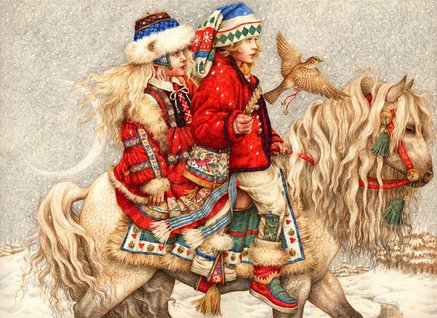
Illustration: This is a small copy of piece by Yvonne Gilbert, a well known painter and illustrator of children's books including Per and the Dala Horse by Rebecca Hickox, A Christmas Star Called Hannah by Vivian French, Tutankhamun: The Life and Death of a Pharaoh by David Murdoch and The Dictionary of Fairies and Iron Wolf, both by Richard Adams. Ms. Gilbert lives and works in England. This image comes from one of her annual holiday cards. More of her images can be seen at her homepage.

Monday, December 11, 2006

Seasonal Silliness: Can We Find Harmony in Difference?

Posted by Picasa

Tis the season to be silly....

They are fighting over Christmas Trees at the Seattle airport. A Rabbi saw their 14 decorated trees and asked for a Hanukkah menorah to be added to the display. In the spirit of peace and goodwill, airport officials said "Nope" and took down all the trees in the middle of the night. The Rabbi, horrified, said that this was not what he wanted. People complained, and now the trees are back up. A menorah may be added next year. Somewhere during the Christmas Wars, the dominant culture forgot that these trees are actually Pagan symbols.

This quote at Tolerance.org sums up the way I feel about this issue.

"Tolerance is respect, acceptance, and appreciation of the rich diversity of our world's cultures, our forms of expression and ways of being human. Tolerance is harmony in difference." (UNESCO)

"We view tolerance as a way of thinking and feeling — but most importantly, of acting — that gives us peace in our individuality, respect for those unlike us, the wisdom to discern humane values and the courage to act upon them."

I love the idea of “harmony in difference”. For those of us who are Sci-Fi geeks, it's very Star Trek. I also love the concept of "peace in our individuality" and the note about courage and wisdom is very much like the work we do in the Spiral Steps Support Groups.

This is why I wrote The Christians and the Pagans. It is also why Spiral Steps is open to all who respect earthwise ethics. We could have made Spiral Steps a Pagan only group (1) but recovery is so much wider and deeper than that. If I had made our groups into a Pagan ghetto then I would be cutting us all off from the lessons we could learn from people with a different life experience or worldview. So I made it about ethics and values, instead, which is something that people on different paths can share. I, for one, have a lot to learn, and I need as much life wisdom and as many examples of right action as I can find.

So, since I believe in holding the mirror up to my own soul, I have to ask this question: What are my own challenges with tolerance these days? Well, for example, I have my arguments with Islam. The fundamentalist version of this belief system is as dysfunctional and toxic as the fundamentalist (read authoritarian) versions of Christianity, Judism, and Paganism. (Plus that "abhore the infidel" thing has a frighteningly familiar ring to it). And yet they do attempt to focus on charity and justice. So, I've ordered some books about the history of this religion, and I'm looking at the ways in which women in these regions stand up for their rights, both within this religion and outside of it. My question is this: What are the values that we share? and How can we live in peace with our differences?

I'm also looking into pre-Islamic culture. There is some fasinating stuff there. The crescent and the star symbols seem to have originally belonged to a goddess very much like Diana. (Well, well.). There was a fasinating period of semi-tolerance, high culture, and scientific exploration in Spain when it was controlled by Islamic rulers in the middle ages. Christians, Jews and other religions all had rights. Women did OK, many owned businesses, and in some cases women and Jews fared better then they did when the Christians took over the region. It's interesting reading thus far.

Sia

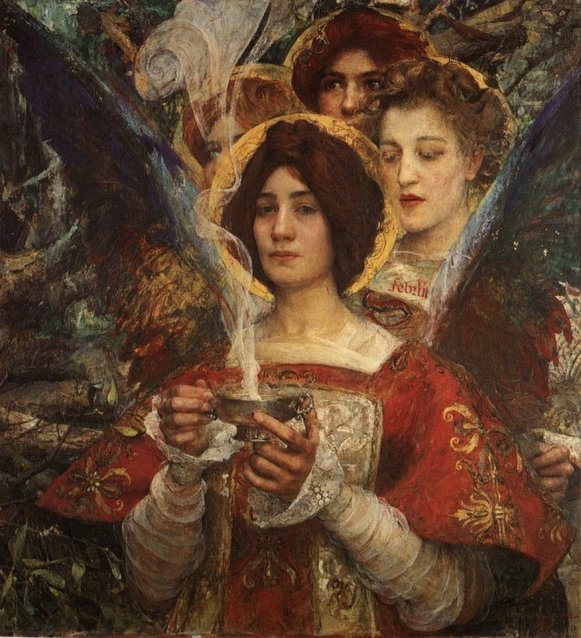
Regarding art: Is she a saint, a goddess, a priestess or something else entirely? You decide.